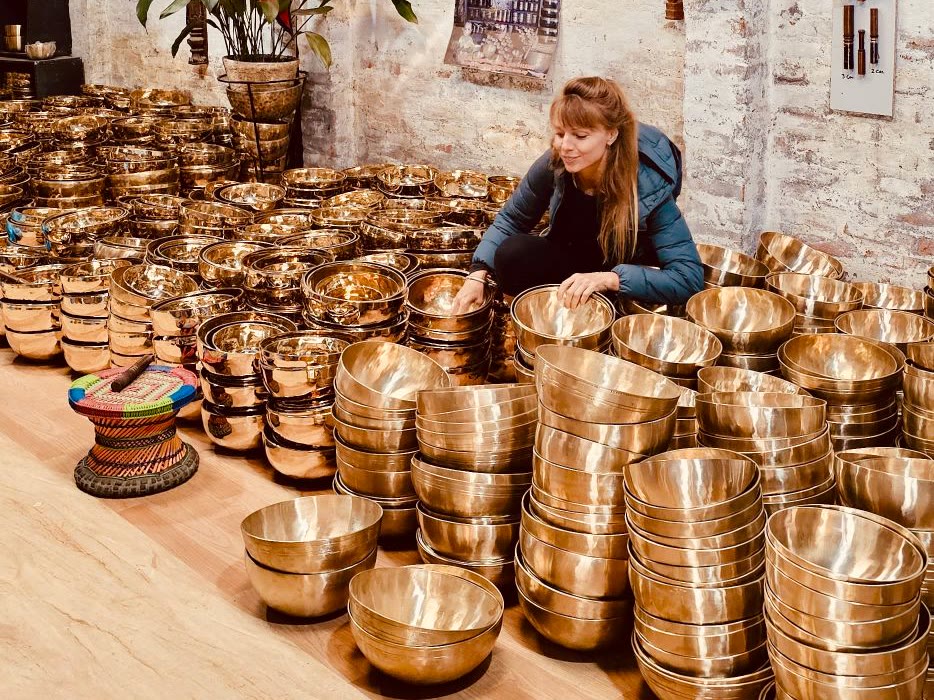
People often come to me knowing they want a bowl, but uncertain about almost everything else. They'll say: I don't know what size. I don't know what tone. I just know I want one. This is, in my experience, a perfectly good place to start—and often a more honest starting point than people who arrive with a very specific list of specifications that turns out to be borrowed from somewhere else.
So if you're in that first camp, let me try to give you a useful framework. Not a checklist—bowls resist checklists—but a set of questions worth sitting with before you choose.
What is this bowl for?
This is the first question, and it's not as obvious as it sounds. A bowl for personal daily meditation has different requirements than a bowl anchoring a group sound bath. A bowl for a clinical setting—a therapist's office, a wellness studio—has different demands than one for a home altar. A bowl intended as a gift for someone else asks something different again.
The reason this matters is not so you can narrow your options mechanically, but so you can hear the bowl in context. When I'm holding a bowl in a market in Kathmandu, I'm trying to imagine it in the space it will eventually inhabit. A large, full-bodied Jambati with a long, rolling sustain can fill a room and hold a room—but in a small apartment it might feel overwhelming. A smaller bowl with a bright, precise tone might be exactly right for intimate meditation but get lost in a larger space.
Where the bowl will live matters. How it will be used matters. The person it's for matters most of all.
Size and tone: the relationship
As a general rule—and all general rules in this world have exceptions—larger bowls produce deeper, lower tones, and smaller bowls produce brighter, higher ones. A large Jambati (say, 28–32 cm) will give you a sound that resonates in the chest. A small bowl (10–16 cm) will give you something that resonates more behind the eyes.
Neither is better. They're different medicines for different moments. What I'd gently push back on is the assumption that bigger is more powerful or more serious. Some of the most penetrating, most transformative bowls I've worked with have been mid-sized—responsive, complex, with a note that seems to change as it sustains. It's worth resisting the instinct to equate scale with depth.
The question is not which bowl is the best bowl. It's which bowl is right for this person, this space, this use.
Tone is harder to specify in advance than size, because it's genuinely subjective. Some people are drawn immediately to warm, dark, slightly rough tones—the sonic equivalent of aged wood. Others respond to something cleaner and brighter, more crystalline. Neither is more correct. When I'm assessing a bowl for a client, I'm listening for quality of tone—consistency, complexity, how the note develops over time—not for a particular pitch or character.
The questions I ask clients
When someone asks me to source a bowl on their behalf, here's what I want to know:
What do you already have? If you're adding to a collection or a set, I need to know what's already there. A new bowl should complement the existing sound, not compete with it.
Do you have a relationship with any particular tone or frequency? Some practitioners work in specific frequency ranges for clinical or therapeutic reasons. Others simply find that certain tones resonate with their nervous system in a way that others don't. If you have a sense of this, tell me—it's useful.
Is appearance part of it? Bowls are beautiful objects, and it's perfectly legitimate to care about how a bowl looks. Some clients want something clearly antique—with patina, with the visible marks of age and use. Others prefer something more uniform in appearance. Some want engraving. These are real factors, and they're worth naming.
What's your budget, honestly? I ask this not to limit you but to focus the search. The range of what's available is very wide, and knowing where you are lets me find the best bowl in that range rather than the best bowl in a range you're not actually in.
What I can't tell you in advance
Here is the honest part: I can't tell you which bowl is yours until I'm holding it. I can carry your specifications into a market and let them guide where I look, but the actual selection happens in the body, not on a spreadsheet. I can describe the bowl I find for you—its size, its approximate age, its tone, its character—but the description is always a shadow of the thing itself.
This is the limitation of choosing from a distance, and I'd rather name it plainly than pretend it away. What I can promise is that every bowl I bring back has passed my own threshold—held, played, listened to, assessed for quality and integrity. The bowl I bring you is one I would keep myself, if it were mine to keep.
After that, the relationship between the bowl and the person it's meant for is something only time can establish. But that, too, is part of what makes this interesting.
Ready to find yours? Get in touch and we can talk through what you're looking for.