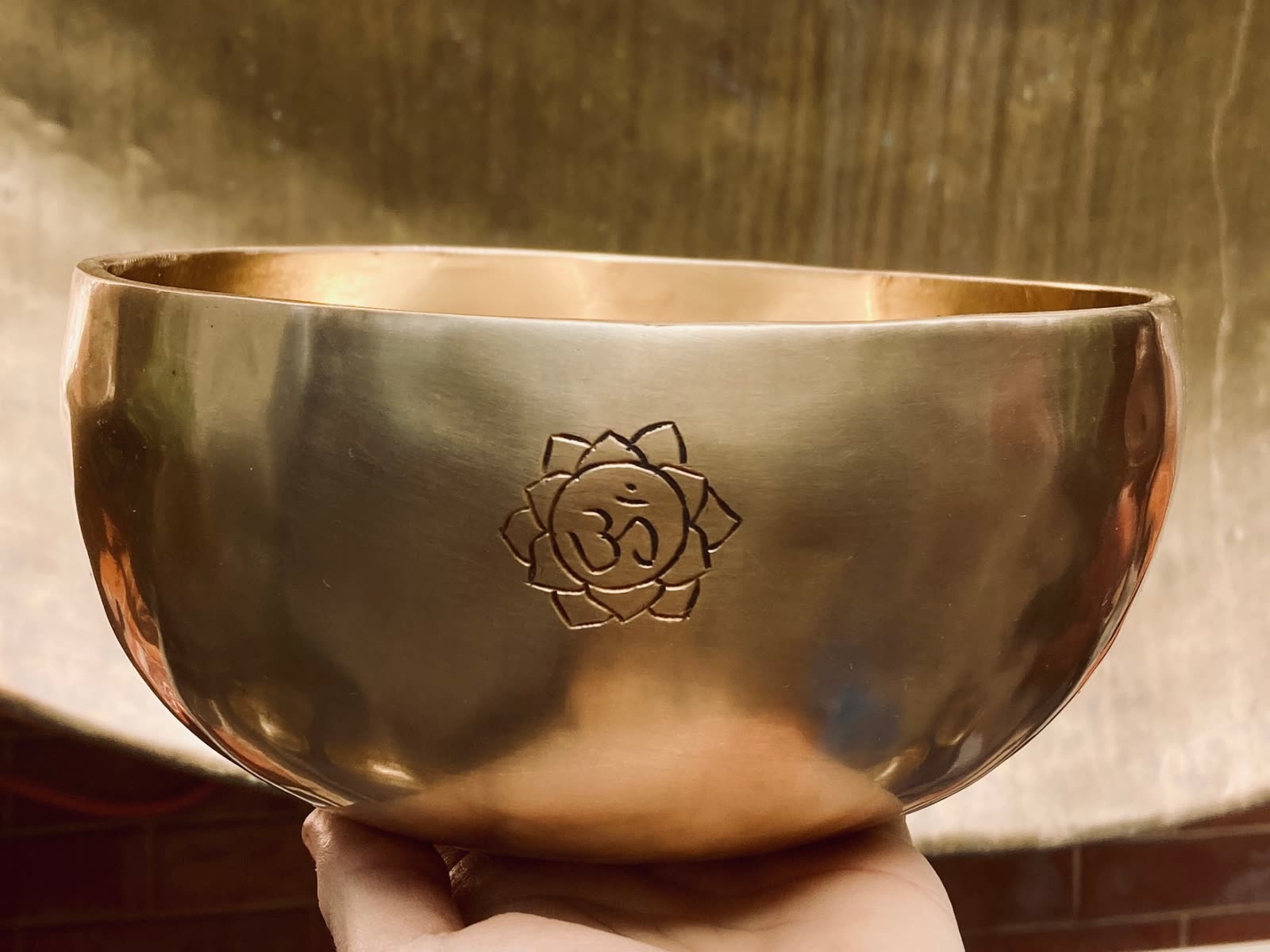
The first time a singing bowl genuinely stopped me, I didn't know what had happened. I had been in a shop in Thamel for about twenty minutes, testing bowl after bowl with the polite efficiency of someone who thinks they already know what they're looking for. Then I picked up a bowl in the corner—large, slightly uneven, patinated to a deep earthen brown—struck it once, and the sound walked into me.
I don't mean it was loud. I mean it went somewhere, found something, and settled there. I stood holding it for a long moment, not thinking, which for me is unusual.
I bought that bowl. I also bought three others that day—bowls I'd chosen with my head, bowls I could describe. I could tell you their approximate age, their probable type, the arc of their sustain. The corner bowl I couldn't describe at all. I just knew.
What listening actually requires
We talk about sound as if it's something we receive, passively, the way light falls on a wall. But there's a kind of listening that's closer to reaching—a whole-body act that requires you to get quiet enough to notice what's already there. Bowls have taught me this more than almost anything else.
In the early days of this work, I listened mostly with my ears. I assessed tone—was it bright or dark, clear or complex? I assessed sustain—how long did the note hold, how cleanly did it decay? These are real things, worth knowing. But I was listening the way you read a résumé, cataloguing credentials, and missing the person entirely.
The bowl in the corner changed that. Not immediately—it took months of sitting with it before I understood what had happened. What I'd felt that day wasn't the sound; it was the sound's relationship to me. The bowl had somehow addressed something I wasn't consciously offering it. And that, I came to understand, is the thing worth listening for.
The body knows first
When I assess bowls now, I try to check my analytical mind at the door—or at least ask it to wait outside. I pick up a bowl, strike it, and notice what happens in my body before I form any thought about it. Does something settle? Does my breath change? Is there a pulling toward, or a mild backing away? These are crude instruments, but they're honest ones.
The mind, given half a chance, will override all of this with a story. This one has a beautiful tone. This one is the size I said I wanted. This one is priced well. None of that is wrong, exactly. But it can drown out something quieter and more important.
The bowl already knows what it is. The only question is whether you're quiet enough to hear it tell you.
I've watched people hold bowls that were clearly not theirs—their body language politely closed, their response cordial but neutral—and then pick up another bowl entirely and visibly change. They'll look up, a little surprised. Sometimes they'll say "oh." Sometimes they won't say anything at all. They don't need to. I can see what happened.
Why this matters for choosing
If you're looking for a bowl for your own practice, this is the most important thing I can tell you: don't let anyone—including me—talk you into a bowl your body isn't responding to. The specifications matter less than you think. Whether it's a Jambati or a Thadobati, antique or new, large or small—these are categories, and categories are useful up to a point. The point where they stop being useful is the moment you actually need to choose.
What I can do, when I source on your behalf, is carry this approach into the market. Every bowl I consider gets held. Every one gets played—not once, but several times, in different ways. I pay attention to what my body says before my mind has had a chance to form an opinion. And then I carry only what passed that test.
The corner bowl has been with me for years now. I still don't have the right words for what it does. I've stopped looking for them.
If this resonates and you're looking for a bowl of your own, get in touch. I'm always happy to talk about what you're looking for.