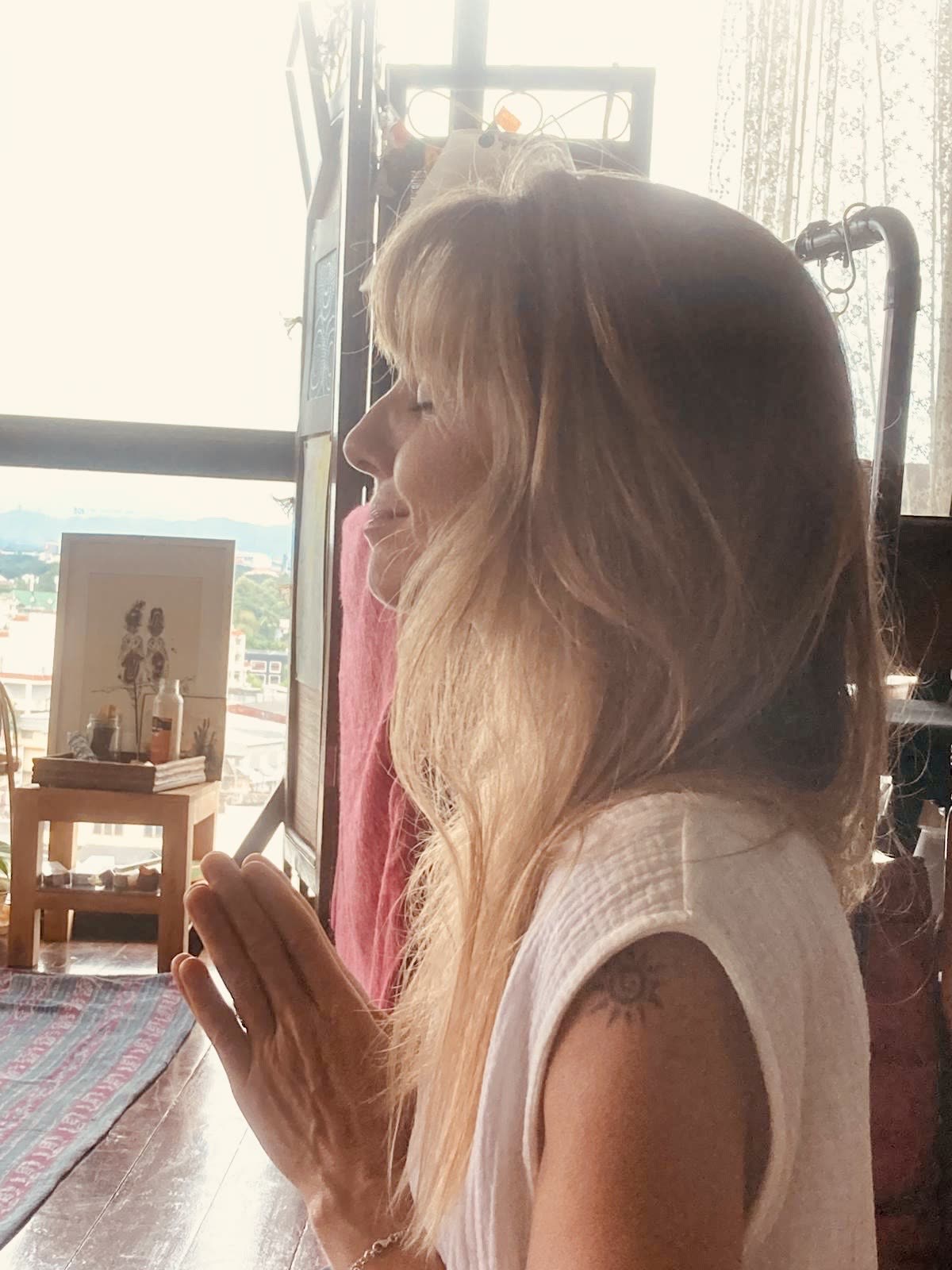
A practice that runs backwards
Most of us spend our lives breathing in what feels good and pushing away what doesn't. It's instinct, and it's a sensible one. Pull your hand back from the hot stove. Lean toward the warm fire.
Tonglen asks you to do the opposite—on purpose.
The word is Tibetan and means something like "sending and taking." It's a Buddhist practice that comes from a body of teachings called lojong, or mind training, which travelled from India to Tibet in the eleventh century. Here in the West, most of us met it through the teacher Pema Chödrön, who has written about it with more warmth and plain sense than anyone.
The practice itself is simple. You breathe in what's difficult. You breathe out what helps.
How it goes
You start with whatever is actually here. Not a hypothetical difficulty, the real one, however big or small. A tightness in your chest. An ache somewhere in your body. A thought you keep circling back to.
As you breathe in, you let yourself feel it fully. You don't soften it or explain it. You let it be as heavy or sharp as it really is.
As you breathe out, you send out relief. Space. A little room around the feeling.
Then, after a few rounds, you widen it. You are not the only person who has felt exactly this way. Somewhere, right now, someone else is sitting with the same tightness, the same thought that won't let go. So you breathe it in for them too, and breathe out relief for both of you at once.
It isn't about making the feeling disappear. It's about no longer being alone with it.
What a bowl knows about this
I think about tonglen a lot when I'm playing.
A singing bowl doesn't flinch when it's struck. It takes the impact completely, all of it, and turns it into sound. The harder knock doesn't get pushed away; it becomes a fuller tone, a longer ring. Take in, give back. That's the whole instrument.
Breath works the same way for a singer. Everything I sing starts with taking air in, all the way down, before anything can come out. You can't skip the inhale and still have a song.
I'm not saying a bowl is a Buddhist teacher (although some days I wonder). I'm saying there's a reason this practice feels so at home in a room full of sound. Both are about letting something move through you instead of bracing against it.
Why do this at all?
Why would anyone choose to breathe in the hard stuff, a feeling they don't want?
Because the bracing is often worse than the feeling. When we tense up against discomfort, we usually add a second layer of suffering on top of the first: the fight with it. Tonglen drops the fight. The difficulty may still be there when you're done, but something has changed, because you stopped holding it at arm's length.
There's a gift in the second half. The moment you remember that other people feel this too, the feeling stops being proof that something is wrong with you. It becomes something human, something shared. Over time, the practice is said to grow a tender, generous heart: one that can take in a lot and still stay open to the world.
Practice with me
Find a seat that lets you stay alert but not tense. Close your eyes, or let them rest softly open. And come as you are, with whatever is here today.
Read the transcript
Welcome. Come to a sitting position in whatever way lets you be at ease and still awake. On a cushion, a chair, and the edge of a bed. Let the spine find its own height. And if today asks you to lie down, then lie down. This practice is not particular about where it finds you. Let your hands come to rest. Let your eyes close or lower your gaze to the floor just a little way ahead. And take one breath that is longer than your usual. And let it leave you through the mouth.
This practice of tonglen is Tibetan. And it means something close to sending and taking. It's very old and very simple and it's not always easy.
All our lives we've been taught a sensible arithmetic. Keep what is sweet, refuse what is bitter. And the body learned it long before we had words for it. Lean toward the warmth. Snatch the hand back from the flame.
There is wisdom in that. And there is also a cost. Somewhere along the way, the refusing becomes a posture, a held breath. A door kept on the latch against our own sorrow and everyone else's. Tonglen lifts the latch. On the in-breath, we take in what is difficult. On the out-breath, we give away whatever might help.
A singing bowl knows this practice. It takes the mallet's whole strike into its bronze and it gives back its song.
Take one slow breath in and follow it all the way out to its end.
Feel the ground receiving your weight. It has been doing this all day, asking nothing of you in return. And notice where you are held. The sit bones, the back of the thighs, the soles of the feet.
Listen outward for a few moments. Whatever sounds arrive, let them be the world going about its business.
Then turn your listening inward to the breath. Letting it be just as it is, faithful your whole life. Let it rise and fall and rise and fall.
Before we take anything in, rest for a moment in openness. Let your mind be a sky. Thoughts may cross it and feelings and the small birds of sound. The sky holds no opinion about any of them. It goes on being wide.
Now give the breath a texture and breathe in what is heavy, hot and dark. Like the air before thunder or smoke or a closed room. Let it enter not only through the nose but through the whole of the skin and the whole surface of you. Breathe out what is cool, clear and bright. Snowmelt. The first air of morning. Light loose on the water.
Breathe in the dense and the dark. Out the clean and the clear. And stay with this a while at your own pace until the rhythm belongs to you.
Perhaps some part of you hesitates at the threshold of the heavy breath. That hesitation is old and loyal. Thank it. Then breathe in anyway, gently.
Now let something real come forward and something you are carrying. It might be small, a tightness under the breastbone, an ache that keeps returning to the same address. A worry you've turned over so many times its edges have worn smooth. Whatever is honestly here is enough.
And if at any point this feels like too much, come back to the open sky for a few breaths and you can return when you're ready.
Let the story fall away from the feeling. The who and the why. And what remains is sensation. Where does it live in you? What's its weight, its temperature, its colour? What would it be like to touch? Sharp, or brittle? Rough? Sticky?
Breathe it in. All of it. Let it come in unsweetened at its full weight. Then breathe out its opposite quality. Smoothness, warmth, space.
You might also sense a feeling underneath it. Sadness or grief or fear. Whatever its name, breathe it in. And breathe out its opposite, its antidote.
Breathe in sadness. Breathe out solace. Breathe in grief. Breathe out comfort. Breathe in fear. Breathe out steadiness. Breathe in loneliness. Breathe out belonging. Breathe in shame. Breathe out acceptance.
Whatever the feeling that visits you today. Breathe it in and breathe out its antidote. Take in the hard thing. Give back what helps.
There's nothing to forcefully change here. You are simply choosing to stay with a feeling.
Think of a child who comes to you with a scraped knee. You wouldn't send her away. You'd comfort her. Make that room for yourself now.
Breathe in pain. Breathe out relief.
Let someone you love come to mind now. Someone who is having a hard time. Picture their face in your mind. Let yourself sense what they might be carrying.
As you breathe in, take a little of their trouble. Their fear, their grief, their weariness. Let it leave them and come to you.
As you breathe out, send them what might help. Rest, perhaps, or courage. The relief of being understood.
Their sorrow, received. Your tenderness, returned.
If it grows too heavy, come home to yourself for a few breaths. Take in your own overwhelm and give yourself back ease. Then return to them when you are able. This practice asks for a soft open heart.
Now let the circle widen. Whatever you felt today, others have felt it before you. And others are feeling it now.
At this very hour, someone sits with the same tightness, the same ache, the same sleepless turning. Many someones, down the street and across the water. In kitchens and hospital corridors, in parked cars, in rooms alone.
Breathe in for all of them. Breathe out for all of them. Let what you send out keep travelling. Let it permeate the walls and past anywhere you could follow.
What so many of us carry, in. What so many of us need, out.
Here is the gift folded inside this practice. The feeling may remain, but it is no longer evidence that something is wrong with you. It's evidence that you are human and that you belong to all the others who are.
Let a few images pass through you and welcome each one and let it go. A tree drinking the breath we've finished with and returning the breath we need. A fist, deciding to become an open hand. Your own heart: a spacious valley with room enough for all weather.
Let the practice go now and let the breath return to its own natural rhythm.
How is the heart? Softer, maybe. More raw. Maybe nothing much has stirred and that's okay.
Tended over time, tonglen makes a heart both tender and spacious. A heart that can take a great deal of the world and still keep its door open.
Begin to return. Feel the weight again and the ground receiving it. Air against the skin. The ordinary sounds of the room and the world beyond it.
Let some small movement come and the fingers and the toes and the jaw and whatever wants to stretch.
As you step back into your day, here is something to carry. What hurts can be breathed with and you have never once breathed alone.
When you're ready, open your eyes. The practice of tonglen is complete. Thank you for breathing with me. Be well.
When you're done, notice what's different, if anything. Or notice that nothing feels different yet. Either way is fine.
If you'd like to rest in sound together, come and join me for a sound journey. Message me on WhatsApp →
And if you missed it, On Resonance is about why lying in sound with other people helps your body learn what safety feels like.
For the curious
- Start Where You Are by Pema Chödrön: her guide to lojong and tonglen, and still the friendliest way in
- Tonglen: The Path of Transformation by Pema Chödrön: a short book on this practice alone